English Willow vs. Kashmir Willow: Which Cricket Bat Should You Buy?
Every cricket bat buyer eventually runs into this question, and the honest answer is: it depends on how and how often you play, not which one is objectively "better." Here's a straight comparison.
The Core Difference
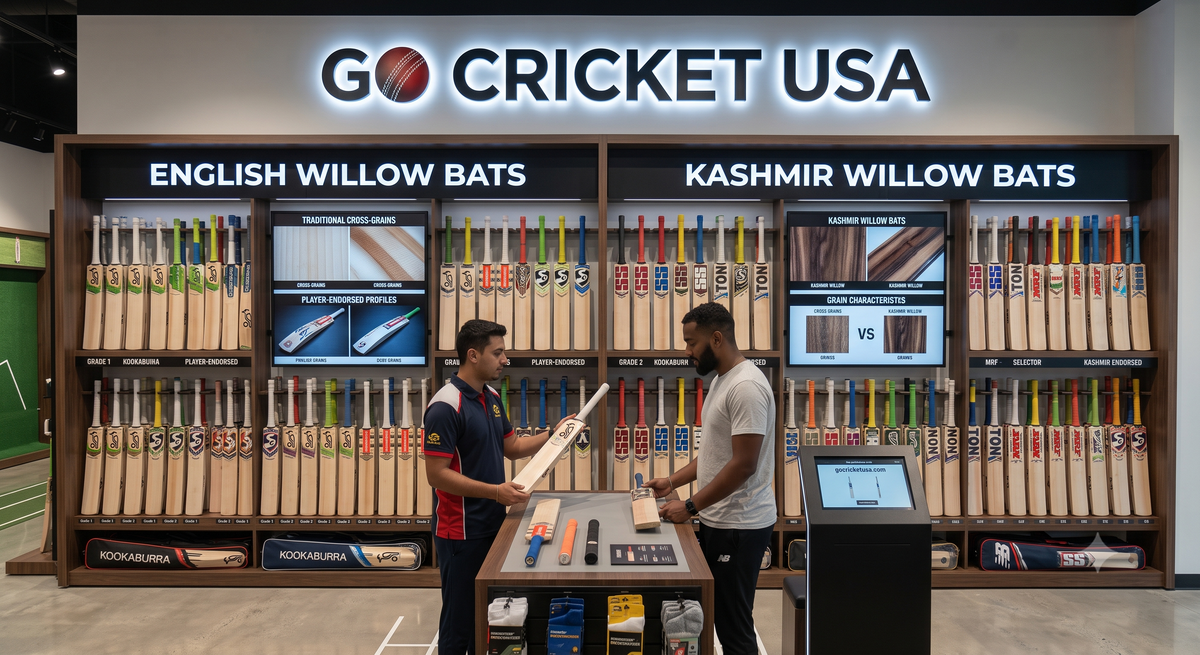
English willow (Salix alba caerulea) is grown in cooler, wetter climates — mainly England — which produces a lighter, softer wood with wider grain spacing. Kashmir willow is grown in the Indian subcontinent's climate, producing a denser, harder wood. That density difference is the root of almost every practical difference between the two.
Performance
English willow wins here, clearly. Its lower density means a bat can be made lighter without sacrificing size, leaving more wood mass concentrated in the hitting area. The result is a bigger, more responsive sweet spot and noticeably more power transfer on well-timed shots. Kashmir willow bats, to reach a comparable weight, typically need a smaller profile — which shrinks the sweet spot. Played side by side, most intermediate-and-above players can feel the difference within a few shots.
Durability
Kashmir willow wins here. Its higher density makes it more resistant to surface damage and less prone to cracking from mishits or inconsistent knocking-in. This is a big part of why it's the standard recommendation for junior players and beginners — the bat can tolerate a less-than-perfect break-in process and rougher handling.
Weight and Feel
For the same physical size, Kashmir willow bats are heavier. Manufacturers compensate by making Kashmir bats with thinner profiles, which is part of why they feel noticeably different in the hand — less concave shaping, thinner edges, and a flatter face compared to a modern English willow profile.
Price
Kashmir willow bats typically run $30–$100, while English willow spans a much wider range — roughly $100 at the entry grade up to $1000+ for player editions. The price gap reflects both raw material cost (English willow is imported and more selectively graded) and the more elaborate profiling/pressing that goes into performance bats.
Knock-In Requirements
English willow needs a proper, patient knocking-in process — typically 4–6 hours of graduated mallet work — before it's safe to use with a hard ball. Rushing this is the most common cause of cracked bats. Kashmir willow is more forgiving here; while knocking-in is still recommended, the denser wood is less likely to split if the process is rushed or skipped.
Who Should Buy Which
| Buyer | Recommendation |
|---|---|
| Junior players (under ~12) | Kashmir willow |
| Beginners / casual and social cricket | Kashmir willow |
| Tennis-ball or backyard cricket | Kashmir willow (or a dedicated tennis-ball bat) |
| Club-level hard-ball players | English willow |
| Serious/competitive players, teens and up | English willow |
The Bottom Line
If you're brand new to cricket, don't overspend on English willow before you know you'll stick with the sport — a Kashmir willow bat will teach you the fundamentals just fine and survive the learning curve. Once you're playing hard-ball cricket regularly and want to feel the difference in your shots, English willow is worth the upgrade.
Browse our Kashmir willow bats or our full English willow range to compare options directly. Not sure which grade or weight is right for you? Check our full bat buying guide or get in touch — we're happy to help.


Leave a comment
This site is protected by hCaptcha and the hCaptcha Privacy Policy and Terms of Service apply.